
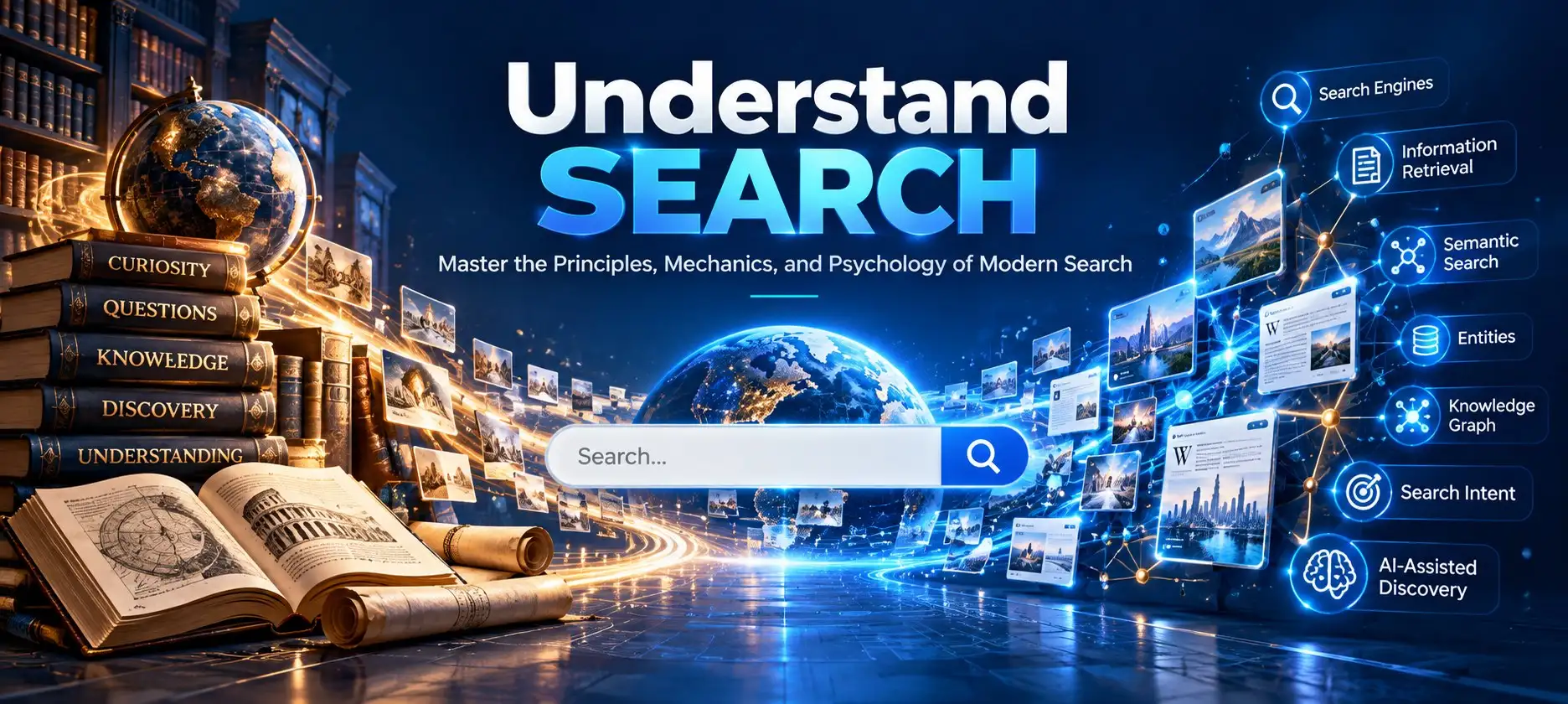
Understand Search
Master the Principles, Mechanics, and Psychology of Modern Search
Introduction to the Course
What This Course Is & Why This Course Exists
Master the Principles, Mechanics, and Psychology of Modern Search
The web began as a collection of documents. In 1999, when servers were configured by hand and Apache logs were read line by line, the question was simple: how do you make a page appear when someone types a query? By 2004, the question had shifted. It was no longer enough to appear. Pages had to rank, and ranking depended on signals no one fully understood.
Algorithms replaced guesswork. Paid links became penalties. Mobile shifted the entire interface. Voice queries changed the grammar of intent. Machine learning replaced keyword matching. Generative answers began summarizing content without sending a click. The tactics changed every quarter. The tools changed every year. The definitions changed faster than the courses teaching them.
What did not change was the underlying principle: someone has a question, and the best answer should surface. That principle does not belong to an algorithm. It belongs to human curiosity. It predates the web, and it will outlive whatever comes next.
This course exists because that principle deserves a stable foundation. It is not a list of tactics that expire with the next algorithm update. It is not a walkthrough of tools that may not exist in five years. It is a structured explanation of how search works, why it works that way, and what that means for anyone creating or finding information online.
The format is written because understanding requires time and revisiting. The structure is linear because concepts build on each other. The access is free because foundational knowledge should not sit behind a paywall. The focus is understanding before implementation, because tactics without understanding become obsolete the moment the system changes.
This course is for anyone who wants to understand search, not just react to it.
Designed as a linear masterclass and a lasting reference for how search actually works.
Foundations
How search engines crawl, index, and rank — plus keywords, content, and site structure.
Advanced Systems
Semantic search, schema, rendering, and deep technical SEO.
Authority & Growth
Links, brand trust, local, ecommerce, and where search is heading.
Measurement
Analytics and evaluation so you can tell what is working and why.
What You'll Actually Learn
Foundational understanding that makes SEO tactics make sense — why systems behave the way they do.
Foundations
- Crawl, index & rank
- Keywords & intent
- Content & technical basics
Advanced
- Semantic search & AI
- Schema & structured data
- Rendering & advanced technical SEO
Authority & Growth
- Links & brand trust
- Local & ecommerce search
- Analytics & the future of search
Comparison
How This Course Is Different
Why a complete written reference beats shallow SEO tip lists.
| Aspect | Typical Video / Blog Tutorial | Understand Search |
|---|---|---|
| Content Format | Short videos or shallow tip lists | Deep written articles that explain the why |
| Focus | Tools, tactics, and platform clicks | Principles, mechanics, and mental models |
| Cost & Paywall | Paid courses or subscriptions | 100% Free & Open Access |
Who This Course Is For
Clear expectations to ensure this matches your career goals.
This Course IS For You If...
- Marketers and SEOs who want to understand search, not just follow checklists.
- Founders and content leads who need clear mental models before investing in tactics.
- Readers who prefer deep written references over video courses.
This Course IS NOT For You If...
- People looking only for step-by-step tool tutorials.
- Anyone wanting platform setup playbooks (see the Practitioner Track).
- Quick-fix seekers who skip underlying mechanics.
Guiding Principles
Course Philosophy
The best practitioners learn by understanding fundamentals first, then applying them — not by memorizing checklists.
Depth Over Summaries
Each topic is a standalone article with background, examples, and common mistakes.
First-Principles First
Understanding how search works comes before tactics that go stale.
Democratized Access
High-quality search education without paywalls.
Curriculum Map
Course Structure At A Glance
238 Lessons · 18 Chapters
Phase 1: Foundations
75 lessons · 7 chapters11 lessons
- Introduction
- What Is SEO? A Complete Definition
- Essential SEO Terminology: A Plain-English Glossary
- What Is a Keyword? The Foundation Explained
- How People Search: Patterns, Modifiers & Intent
- The Search Results Page (SERP) Explained
- Understanding Search Intent: The Foundation
- Why E-E-A-T Matters in Search Quality
- Organic vs. Paid Search: Understanding the Difference
- SEO Myths vs. Reality: 20 Misconceptions Explained
- Chapter Glossary
13 lessons
- Introduction
- What Is a Search Engine? History and Evolution
- Crawling, Indexing & Ranking Explained
- How Googlebot Crawls the Web: Crawl Budget Explained
- Why Pages Don't Get Indexed by Search Engines
- How Search Engines Interpret Query Intent
- How Search Engines Rank Pages: The Basics
- Ranking Signals: What Actually Affects Rankings
- Why Two People See Different Search Results
- Google Algorithm Updates: Panda to Helpful Content
- How Google Protects Against Spam and Manipulation
- Why Search Engines Want to Show Good Results
- Chapter Glossary
12 lessons
- Introduction
- Long-Tail Keywords: Lower Competition, Higher Intent
- Seed Keywords and Search Patterns Explained
- Keyword Modifiers: How Search Intent Changes
- Question-Based Keywords and People Also Ask
- Keyword Difficulty & Search Volume Explained
- Buyer Journey Keywords: Awareness to Decision
- Seasonal & Trending Keywords: How Search Demand Changes
- Keyword Cannibalization: Why It Matters
- Competitive Keywords and the Search Landscape
- Primary vs. Secondary Keywords Explained
- Chapter Glossary
14 lessons
- Introduction
- Content Strategy: Planning Before You Write
- Writing for Users and Search Engines
- Content Length and SEO: Does Longer Always Rank Better?
- Matching Content to Search Intent: The Ranking Foundation
- Content Freshness: When and Why Updates Matter
- Title Tags: Why They Matter More Than Any Other On-Page Element
- Meta Descriptions: CTR and User Signals
- Header Tags: Structure for Humans & Search Engines
- Keyword Placement and Relevance in Body Content
- Why Scannability Matters for Content & SEO
- Content Formats: Why Format Must Follow Intent
- Call-to-Action Design: What Comes After Content?
- Chapter Glossary
12 lessons
- Introduction
- Why Site Structure Determines What Search Engines Find
- URL Structure: Why It Matters to Search and Users
- Navigation & Information Architecture Explained
- Breadcrumbs: Navigation, UX & Context
- Internal Linking: Authority & Context Explained
- Anchor Text: Why Internal Links Need Descriptive Text
- Why XML Sitemaps Help Search Engines Find Your Pages
- Robots.txt: How Crawler Access Control Works
- Page Indexation: How Google Decides What to Index
- How Search Engines Map Your Site Structure
- Chapter Glossary
10 lessons
- Introduction
- Crawlability & Crawl Budget Explained
- Core Web Vitals: LCP, INP, CLS Explained
- Mobile-First Indexing: How Google Evaluates Sites
- JavaScript & Rendering: How Search Engines See Pages
- HTTPS & Security: Why Encryption Matters
- Noindex vs. Disallow: When and Why to Hide Content
- HTTP Status Codes and What They Tell Search Engines
- Duplicate Content: Causes and Solutions
- Chapter Glossary
Phase 2: Advanced
66 lessons · 4 chapters14 lessons
- Introduction
- Semantic Search: How Search Engines Understand Meaning
- Entity-Based Ranking: Knowledge Graphs and Search
- Topical Authority: Why Coverage Depth Beats Keywords
- Topic Clusters and Content Pillars Explained
- Featured Snippets & Position Zero Explained
- People Also Ask: Understanding Related Search Intent
- What LLMs Value in Content: Answer Engine Optimization
- AI Overviews: How Google Summarizes Search Results
- Generative Search Models: Where Search Is Heading
- Google Discover & Top Stories: How They Work
- AI Content & Search Engines: What Actually Gets Rewarded
- Zero-Click Search: When Google Answers Without Clicks
- Chapter Glossary
18 lessons
- Introduction
- Schema Markup: What Search Engines Actually Understand
- BlogPosting Schema: How Blog Articles Get Rich Results
- FAQ Schema: What Google Supports and What It Doesn't
- Product Schema: How Search Engines Read Product Data
- Organization Schema & Brand Entity Recognition
- Local Business Schema: How Google Understands Locations
- Review & AggregateRating Schema Explained
- Video Schema and Rich Video Results Explained
- How Image Search Really Works: Context & Schema
- Breadcrumb Schema and Navigation Structure
- Event and Offer Schema for Timely Content
- Custom Schema Types and Advanced Structured Data
- How Search Engines Validate and Use Schema
- Schema Errors and Warnings: What They Mean
- Rich Results & SERP Features: What Schema Enables
- The Future of Schema and Structured Data
- Chapter Glossary
14 lessons
- Introduction
- Hreflang: How Search Engines Understand Language Versions
- International Site Structure: ccTLD vs Subdomain vs Subfolder
- How Search Engines Handle Multilingual Content
- International Ecommerce: Currency, Language & Shipping
- Google's Two-Wave Indexing Explained
- SSR vs CSR: What Rendering Means for Search
- Static Site Generation and SEO Performance
- Dynamic Rendering & Prerendering for JavaScript Sites
- JavaScript Frameworks and Search Visibility Explained
- Headless CMS & JS Frameworks: SEO Architecture Tradeoffs
- How Platforms Render Content for Search Crawlers
- SPAs vs Multi-Page Apps: Crawl Implications Explained
- Chapter Glossary
20 lessons
- Introduction
- Canonicalization and Duplicate Content Explained
- Query Parameters & Faceted Navigation Explained
- How Search Engines Handle Pagination
- Lazy Loading and Image Optimization: SEO Trade-offs
- Caching & Cache Headers: How They Affect Crawling
- Crawling & Indexation: The Full Pipeline Explained
- Redirect Types Explained: 301, 302 and 307
- Redirect Chains and Loops: Crawl Efficiency
- X-Robots-Tag & HTTP Headers: Advanced Crawl Control
- Why Meta Refresh & JS Redirects Cause SEO Problems
- Site Architecture: Breadth vs Depth Explained
- Orphaned Pages: Why Crawlers Can't Find Them
- Posts vs Pages: CMS Structure & SEO Implications
- Page Speed Layers: CDNs, Caching & Lazy Loading
- How Bing and Other Search Engines Crawl Differently
- Why Privacy-First Search Engines Rank Pages Differently
- Log File Analysis: Understanding Crawler Behavior
- Crawl Budget: Why It Matters for Large Sites
- Chapter Glossary
Phase 3: Authority & Growth
97 lessons · 7 chapters14 lessons
- Introduction
- Why Links Matter: The Endorsement Model
- Dofollow, Nofollow, Sponsored & UGC Links Explained
- Link Quality: Why Domain Authority and Context Matter
- Anchor Text Patterns & Natural Link Growth
- Natural vs Manipulative Links: How Search Detects It
- Negative SEO: Why Link Tactics Backfire
- Unlinked Brand Mentions & Authority Signals
- Link Velocity and Natural Growth Patterns
- Earned Media & Editorial Links Explained
- Link Building Risks: What Search Engines Penalize
- Brand Authority vs Link Authority in Rankings
- Authority by Industry: How Search Understands Relevance
- Chapter Glossary
14 lessons
- Introduction
- What SEO Measurement Can and Can't Tell You
- Search Console vs GA4: Different Roles in SEO
- Impressions and CTR: What They Reveal
- Average Position: Why the Metric Can Mislead
- Attribution Models & Organic Search Conversions
- Brand vs Non-Brand Search Performance Explained
- New vs Returning Users: What They Tell Us
- Traffic Quality Signals: Bounce, Engagement & Return Visits
- Cohort Analysis: Tracking Content Performance Over Time
- Algorithm Updates: How to Detect and Interpret
- Seasonality and Traffic Patterns: Normal vs Abnormal
- Content Decay: Why Old Content Loses Rankings
- Chapter Glossary
14 lessons
- Introduction
- Local SEO: Pack, Maps, and Organic Results Explained
- Local Ranking Factors: Proximity, Relevance, Prominence
- Google Business Profile: What It Is and Why It Matters
- Why Review Volume and Recency Move Local Rankings
- What Are Citations in Local SEO?
- Local Keywords: City, Neighborhood & Near Me
- Service Area vs Storefront: How Local Search Works
- Multi-Location Sites: How Search Engines See Each Branch
- How Search Engines Connect Business Listings
- Local Spam and Black Hat Tactics in Local Search
- Yelp, Apple Maps & Bing Places: Local Search Beyond Google
- Local Search for Professional Services & YMYL
- Chapter Glossary
16 lessons
- Introduction
- Brand Search Demand: A Ranking Moat
- How Search Engines Build Brand Entities
- E-E-A-T Explained: What Makes Content Trustworthy
- Author Pages and Personal Brand Authority
- Online Reputation and Rankings: The Connection
- How Review Patterns Shape Brand Perception in Search
- Fake Reviews and Spam: How Search Engines Detect Them
- Knowledge Panels: How Google Displays Your Brand
- Social Profiles and Brand SERP Reality
- Earned Media and Third-Party Validation
- How Brand Sentiment Affects Search Behavior
- Crisis Communications & Brand Visibility in Search
- YMYL and Healthcare: Why Stricter Rules Apply
- Brand Building vs Short-Term Rankings in SEO
- Chapter Glossary
16 lessons
- Introduction
- Ecommerce SEO: Categories, Products & Content Explained
- How Search Engines Handle Large Product Catalogs
- Product Variant Strategies: Color, Size & SKU
- Faceted Navigation and Filtering in Search
- Duplicate Product Content: Manufacturer Descriptions
- Internal Linking for Product Discovery
- Why Product Pages Rank Differently in Search
- Category Pages: When and Why They Rank
- Why Product Schema Must Match the Page
- How Product Reviews Influence Trust and Visibility
- Marketplace SEO vs Your Own Site Explained
- Image and Video SEO for Product Pages
- Ecommerce Blog Content and the Buying Journey
- When International Catalogs Compete in Search
- Chapter Glossary
18 lessons
- Introduction
- AI Overviews and Generative Search Explained
- What AI Systems Value in Content (LLMs vs Google)
- Answer Engines vs Search Engines: Different Models
- Zero-Click Search: Why Google Answers Without Clicks
- Multimodal Search: Images, Video & Voice Explained
- Voice Search and Conversational Queries Explained
- Finding Information Without Searching
- Vertical Search: Why Different Searches Get Different Results
- App Store Search and Search Everywhere Explained
- Emerging Search Surfaces and Platform Shifts
- Privacy Laws and SEO Measurement
- First-Party Data in a Cookieless Web Explained
- Search Beyond Google: Bing, DuckDuckGo & Brave
- Algorithm Speculation vs Confirmed Facts in SEO
- Predicting Search's Next 5-Year Evolution
- SEO Resilience: Why Some Strategies Survive Change
- Chapter Glossary
Lesson Sample
What Lessons Actually Look Like
Open a sample from this course to see the lesson style.
Introduction
Introduction
Most people who want to understand search end up in the same place: tutorials about tools, checklists of tactics, and advice that changes every six months. They learn what to do without ever understanding why it works. This course exists to fix that. It is built around one premise: understanding how search actually wor...
Sample Lesson · Introduction
Introduction
Most people who want to understand search end up in the same place: tutorials about tools, checklists of tactics, and advice that changes every six months. They learn what to do without ever understanding why it works. This course exists to fix that. It is built around one premise: understanding how search actually works is more valuable, more durable, and more transferable than any collection of tactics.
This introductory chapter sets the foundation for everything that follows. Before exploring search psychology, ranking signals, or how search engines interpret content, it helps to understand what kind of course this is, what it is not, and why that distinction matters. The goal is not to hand over a playbook. The goal is to build a mental model of search that holds up when algorithms change, when tools disappear, and when new platforms emerge.
Search is not a technical mystery reserved for specialists. It is a system built around human behavior, and like any system built around human behavior, it follows patterns that can be understood. Once those patterns are clear, the surface-level tactics start to make sense on their own terms (not as rules to memorize, but as logical outcomes of how the system works). That shift in understanding is what this chapter introduces.
What We Will Cover
This chapter contains one foundational lesson that frames the entire course before the deeper concepts begin.
- Understand what this course is actually about (and what it deliberately leaves out) so the learning that follows has a clear frame of reference.
- Recognize the difference between understanding search and learning to operate search tools, and why that distinction shapes how knowledge compounds over time.
- See a concrete example of the kind of understanding this course builds: why two nearly identical pages can rank completely differently, and what that reveals about how search systems actually evaluate content.
- Understand how to use this course in a way that fits how you actually learn (whether that means reading straight through or navigating by concept) without any software, setup, or prior technical knowledge required.
Why This Matters
There is a persistent gap in how search is taught. The majority of available resources focus on execution: which settings to configure, which metrics to watch, which content formats are performing well right now. That knowledge has a short shelf life. Algorithms shift. Platforms evolve. Tools get acquired, rebranded, or retired. Anyone whose understanding is built entirely on current best practices finds themselves rebuilding from scratch every few years.
Understanding the underlying mechanics of search does not expire in the same way. Why search engines reward certain signals, how search intent shapes ranking decisions, what makes one piece of content more trustworthy than another to both humans and algorithms: these are not arbitrary rules. They are the logical outputs of systems designed to serve human information needs at scale. When those foundations are clear, changes to the surface layer become easier to interpret and adapt to.
This chapter matters because it establishes the lens through which everything else in the course should be read. It is not a warm-up or a formality. It is the first step in reframing search from a set of instructions into a system that can be genuinely understood. That reframing is the most useful thing this course can offer, and it starts here.
Why Is This Course Free?
Foundational knowledge about search should be accessible without paywalls.
- No email paywall or trial expiration
- No upsell consulting pitches
- Updated as search evolves
How To Use This Course
Approach it as a sequential masterclass or an on-the-job reference.
Zero Fluff. Clear Mental Models.
Work through this material and you will understand why pages rank, how engines evaluate quality, and where search is heading.
Next Step
Choose Your Learning Path
Pick a starting point based on where you are today. The fastest path is still sequential.
New to Search
Start with foundations: how engines work, keywords, content, and technical basics.
Technical SEO Focus
Jump into semantic search, schema, rendering, and advanced technical SEO.
Growth & Channels
Focus on authority, analytics, local, brand, and ecommerce search.
Welcome to Understand Search. Let's Begin.
Start exploring lessons immediately — no signup required to read.
Drop Me A Message
Let’s start building the high-performance growth engine your brand deserves.
Ready to transform your digital presence into a high-performance engine? Whether you have a specific project in mind or need a comprehensive strategic consultation, I am here to bridge the gap between your current standing and your ultimate market goals. Reach out today to discuss how my specialized infrastructure and AI-driven strategies can scale your business. Fill out the form, and let’s start turning your vision into a measurable reality.
Drop Me A Message
Straight answers
Questions I hear a lot
How do you differ from a traditional agency?
You work with me, not a rotating cast. I audit, build, and train your team. Agencies often keep control and charge forever to run what you could own in-house.
What size of marketing budget makes sense for your services?
Honestly, you need enough marketing activity to make fixes worthwhile. Still very early stage? A course or specialist vendor may fit better. Already running a full in-house team? You probably want a full-time CMO, not me part-time.
Do you work with specific industries?
Yes: logistics, real estate, pro services, SaaS, local trades. Places where online leads hit the P&L fast. I skip healthcare and finance; compliance slows the work down.
What does a typical engagement look like?
Engagements start with a two-week audit of analytics, ads, SEO, and CRM. Then a 90-day plan focused on attribution, conversion, and what's leaking spend. Hands-on build and training along the way; at the end your team runs it.
How do I know if I need a digital marketing consultant versus hiring full-time?
If revenue is growing faster than you can hire marketing, fractional support fills the gap. Interim CMO work until you're ready for a full-time exec. Hiring help is available when you get there.
What happens after the engagement ends?
You keep logins, docs, and dashboards. Engagements are built so your team can maintain and troubleshoot. Some clients book a quarterly check-in; that's optional.

Copyright © 2026 HAMMAD SHEIKH. All Rights Reserved